LIVIT is really a chain of five connected conversations — device to phone, phone to patient, phone to
server, server to pharmacy, and server to the prescription record. Each link has a job, an interface, and a billing code.
The architecture — five links
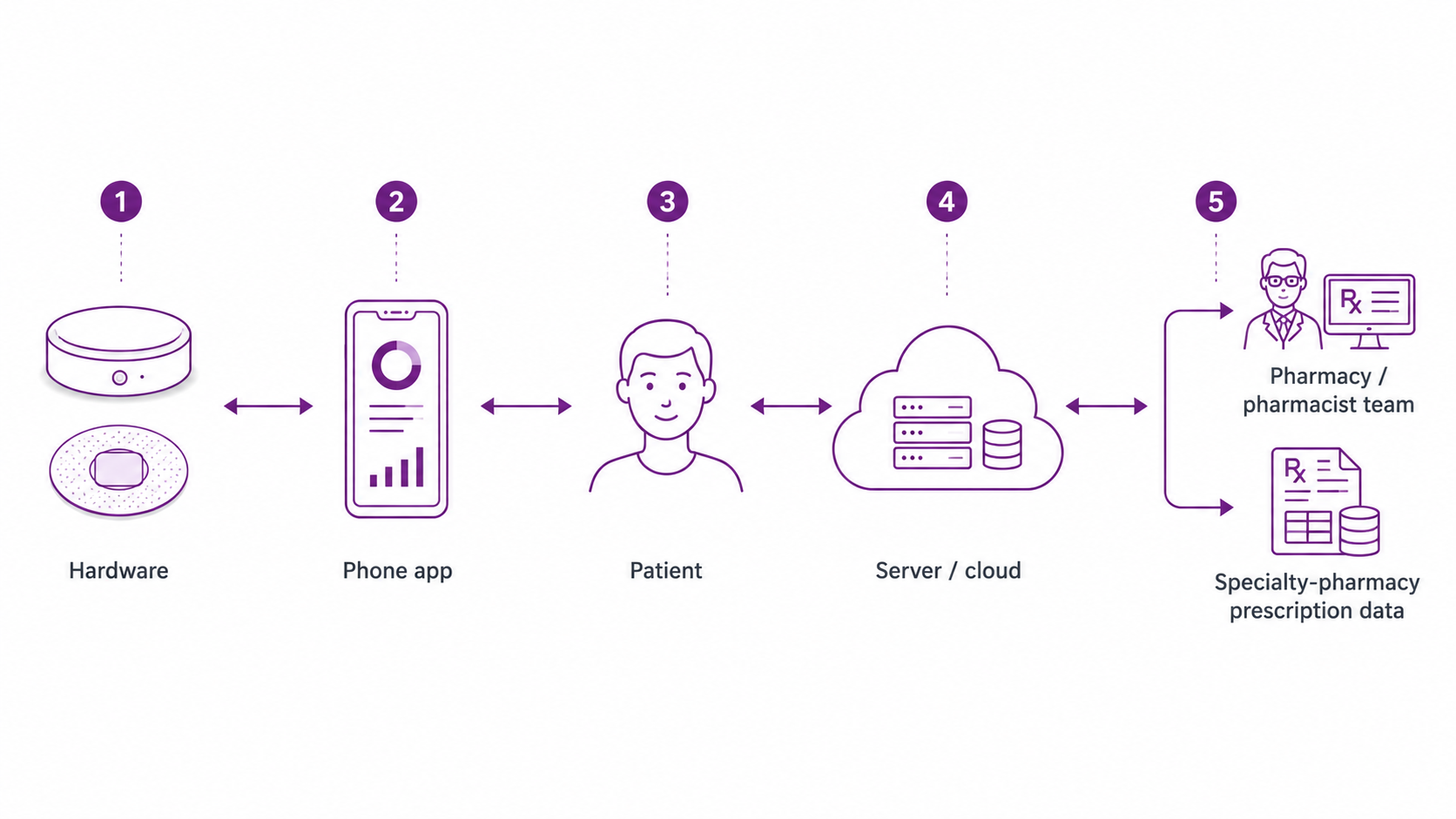
The whole platform is one signal moving through five communication links and back again. The diagram below is the map;
each link is detailed underneath with its app screen and the CPT code it supports.
1 · Hardware ↔ Phone app2 · Phone ↔ Patient3 · Phone ↔ Server4 · Server ↔ Pharmacy5 · Server ↔ Rx data
The five links — hardware → phone app → patient → server/cloud → pharmacy & prescription data.
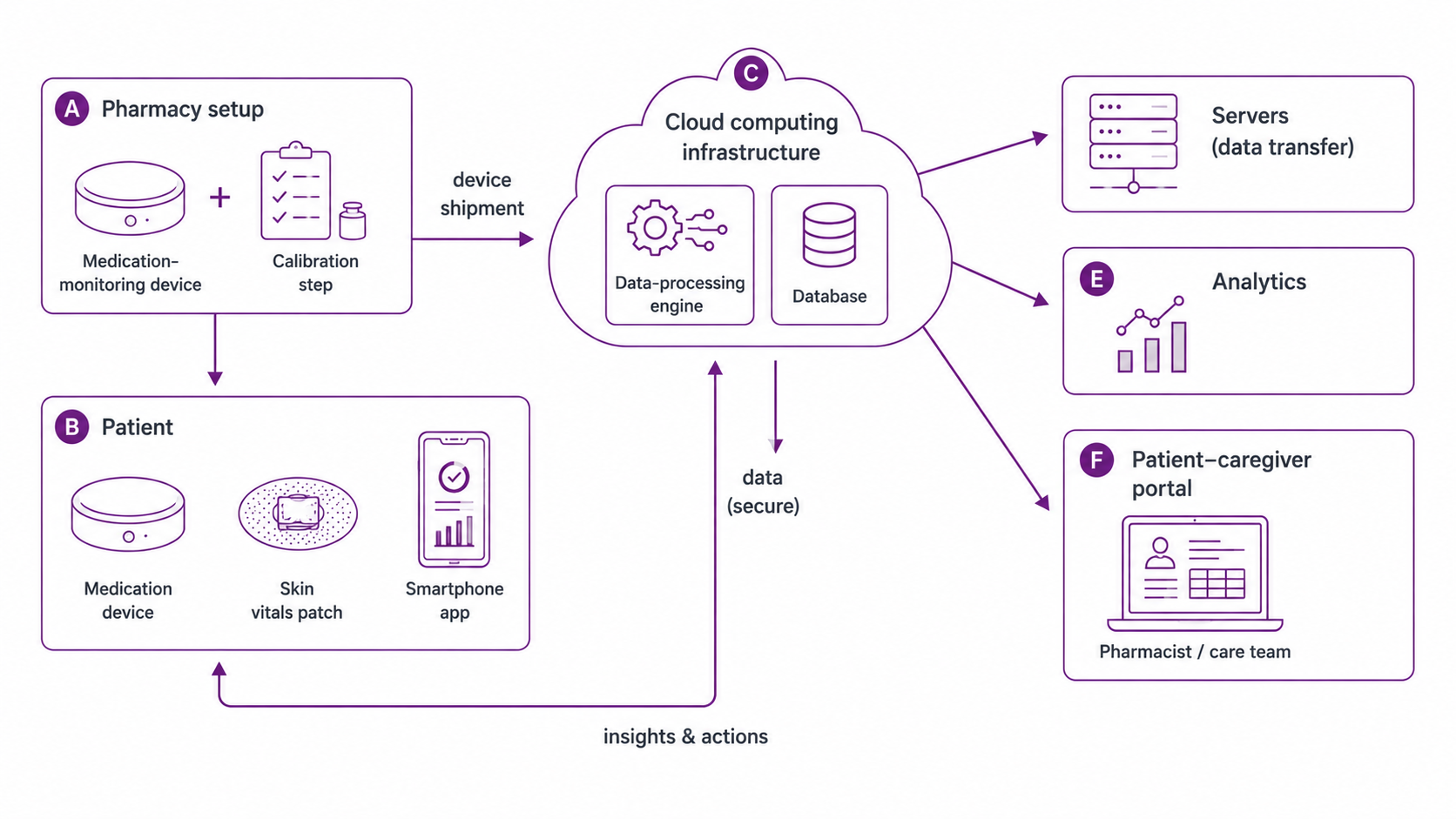
Reference architecture (from the patent)
The patent's system figure shows the same flow in clinical detail. Read it as a loop, pharmacy → patient → cloud → care team:
Pharmacy setup — the medication-monitoring device is activated and calibrated at the pharmacy, then shipped to the patient.
Patient edge — the device + vitals patch + mobile app capture dose and vitals data.
Cloud — data syncs to the cloud computing infrastructure: a data-processing engine and a database.
Servers & analytics — the cloud feeds the servers (data transfer) and an analytics layer.
Caregiver portal — the pharmacist/care team works in the patient–caregiver portal application.
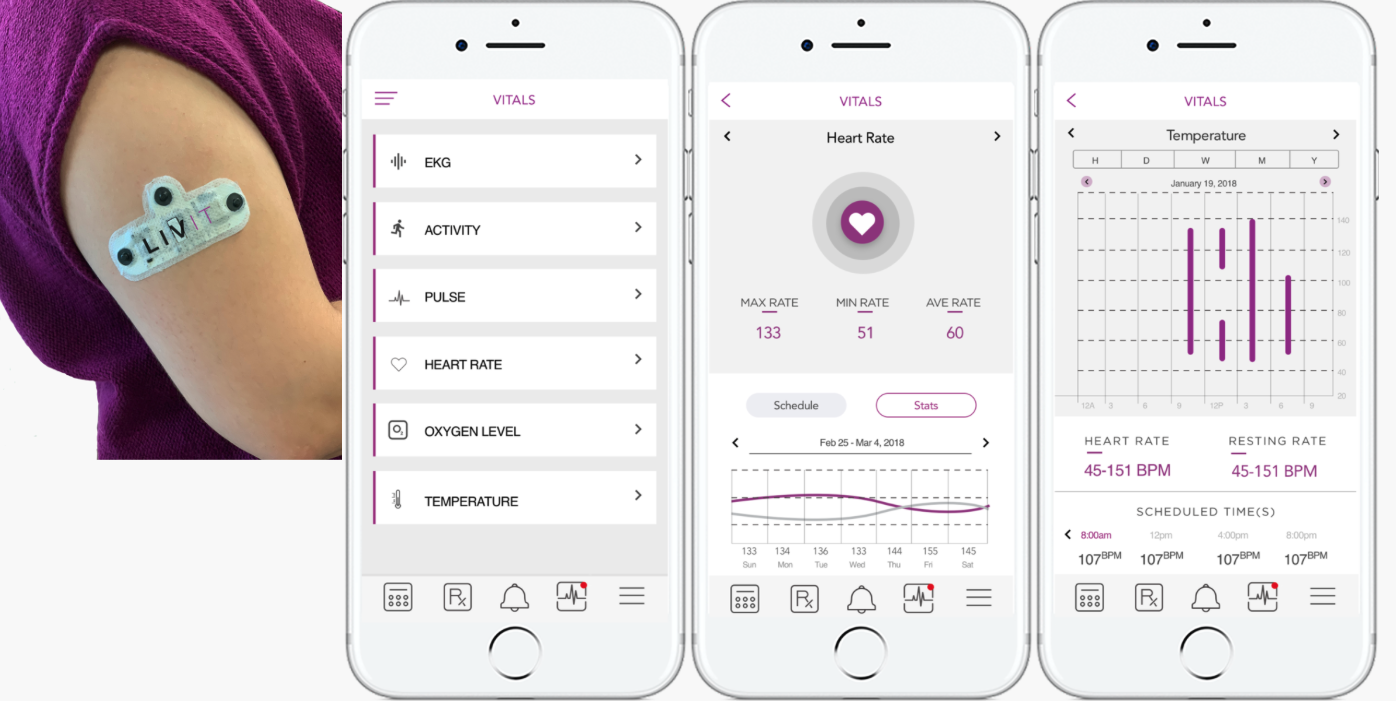
The device and patch stream events to the phone over Bluetooth / Wi-Fi / 4G.
The medication device (load-cell scale) and the vitals patch send their readings to the phone over Bluetooth /
Wi-Fi / 4G. The phone activates and pairs the device — fingerprint + barcode/ship-address verification — and
receives the dose and vitals events at the edge.
Pair & activate the device (biometric + barcode).
Receive dose / weight-change events and vitals.
Buffer offline; forward when connected.
Bills via: RTM device supply — 98976 / 98977 / 98978 (16+ days of device data/30) and setup 98975.
Link 2 — Phone ↔ Patient
2Phone app ↔ Patient
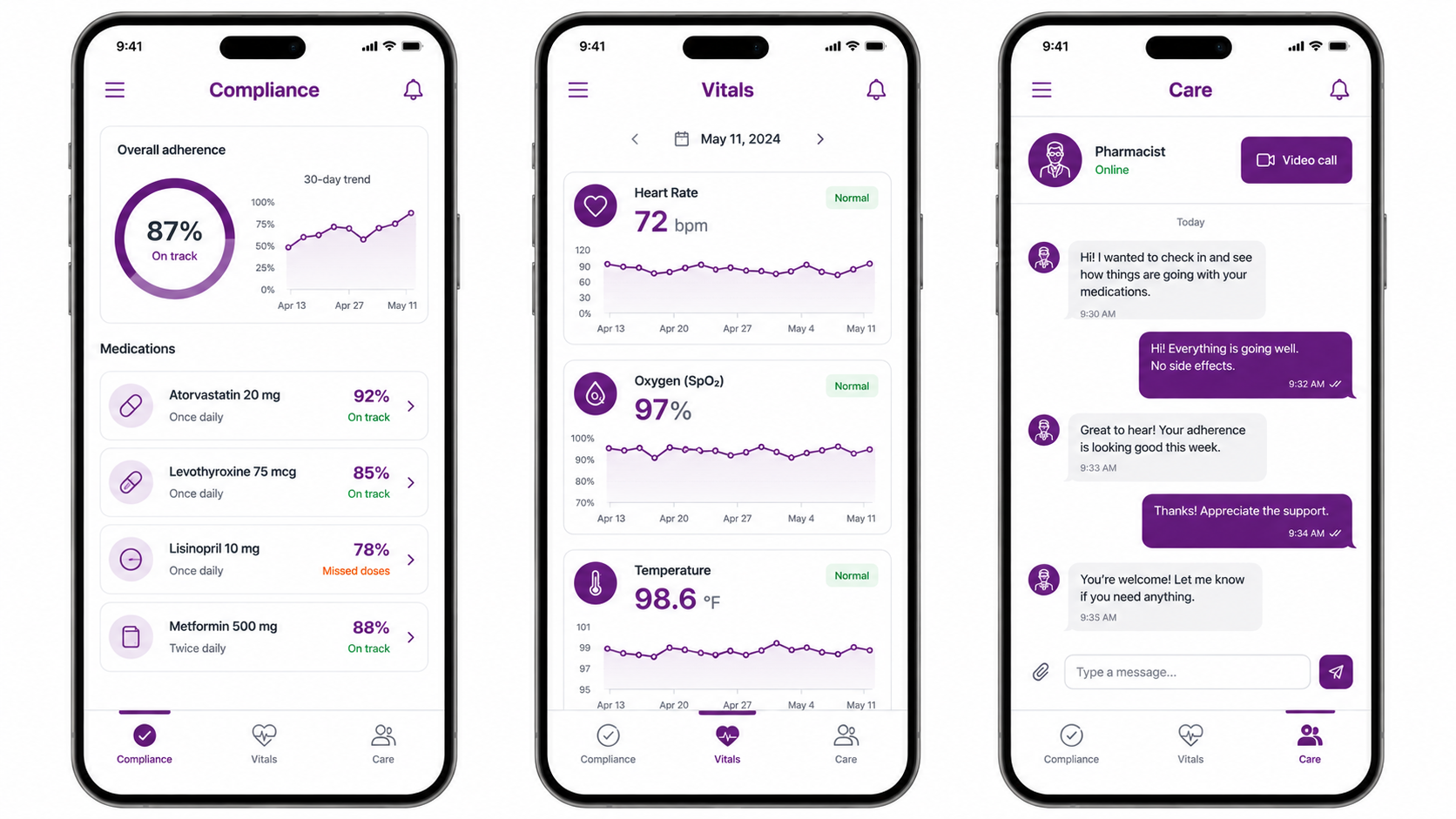
For the patient, the app is purely about three things — their compliance data, their vitals, and a
direct line to the pharmacist by text or video. No clutter.
Compliance data
Doses taken vs prescribed, missed-dose and over-dose alerts, refills — a clear daily and 30-day view.
Vitals
Heart rate, oxygen, temperature and activity from the patch — trends the patient can actually see.
Pharmacist — text or video
A direct, two-way line to the pharmacist/care team: message or video call, no office visit.
The patient app, focused — Compliance, Vitals, and a direct pharmacist line by text or video.
Bills via: RTM patient set-up & education 98975; patient-reported data and the interactive text/video support the RTM device-data and treatment-management requirements.
Link 3 — Phone ↔ Server
3Phone app ↔ Server / cloud
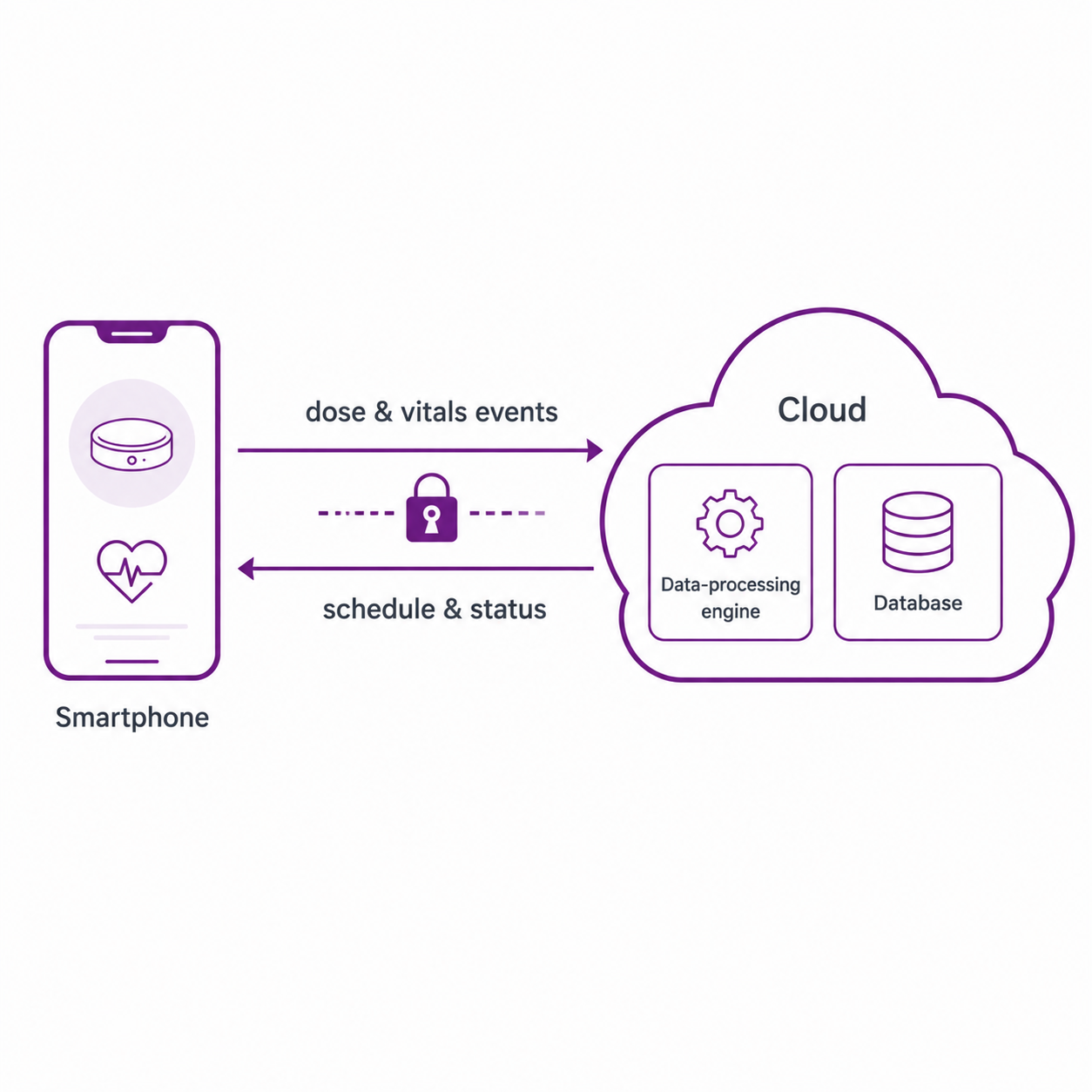
The phone syncs to the cloud — dose & vitals events up, schedule & status down, encrypted.
The phone syncs events to the cloud computing infrastructure — a data-processing engine and database — which
stores each patient's record securely, applies the adherence algorithms, and returns the schedule and any status changes.
Secure per-patient cloud accounts; encrypted in transit & at rest.
Counts the 16+ days of data per 30-day cycle that billing requires.
Bills via: underpins all RTM device codes (98976–98978) — data must reach the server to count toward the 16-day threshold.
Link 4 — Server ↔ Pharmacy (pharmacist team)
4Server ↔ Pharmacy / pharmacist team
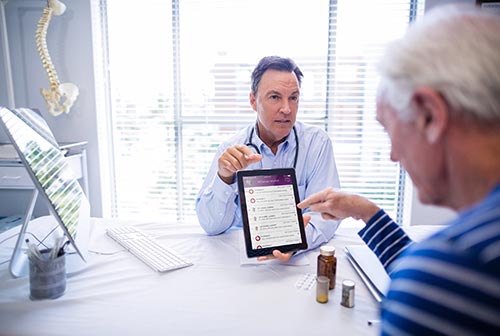
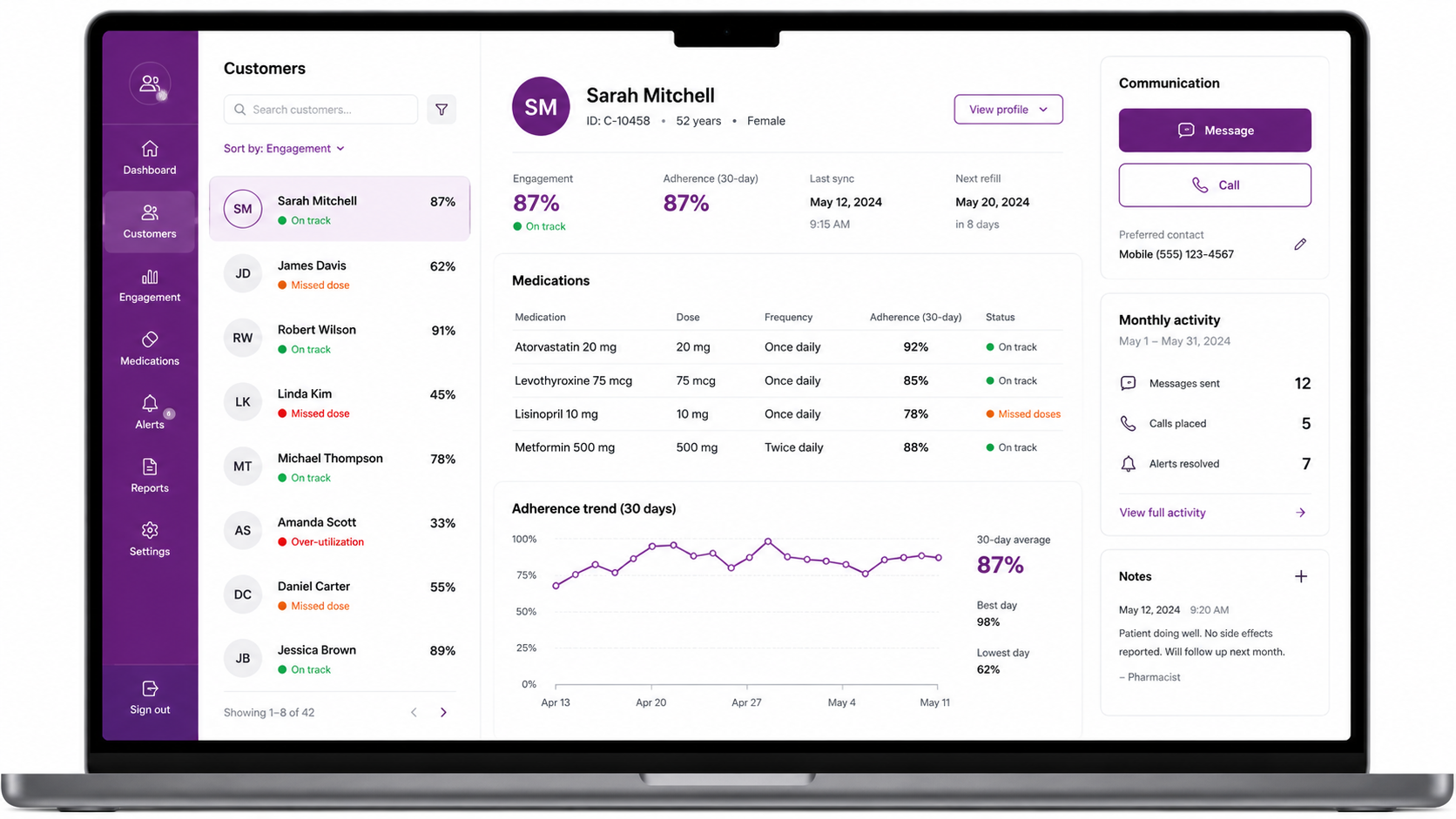
The provider console is where the work — and the billing — happens. The pharmacist team monitors many patients at
once, sees compliance reports and over-utilization alerts, and reaches out: the interactive communication and
time that treatment-management billing requires.
The pharmacist team reviews and reaches the patient — the billable touchpoint.
The pharmacist console — multi-patient adherence, a patient's medication detail & 30-day trend, and the communication panel with monthly activity (the billable contacts & time).
Link 5 — Server ↔ Specialty-pharmacy prescription data
5Server ↔ Specialty-pharmacy Rx data
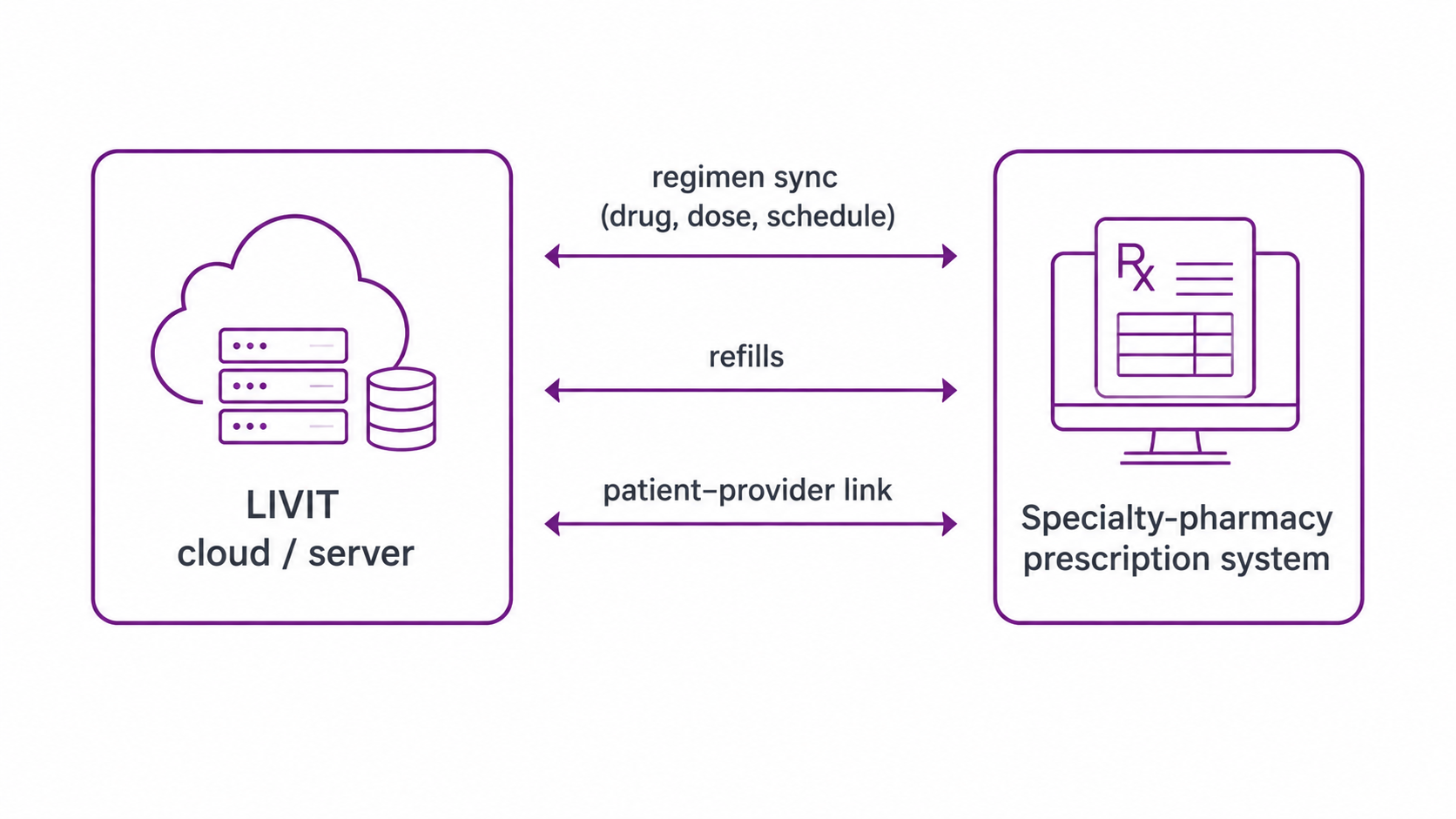
The platform integrates with the specialty pharmacy's prescription / dispensing system: at the pharmacy the
device is activated and the regimen is synced (drug, dose, schedule, refills), and the patient's cloud account is
linked to the pharmacy's provider database. That prescribed schedule is the baseline every adherence calculation runs against.
Regimen sync at dispensing — drug, dose, frequency, special instructions.
Refill & next-fill data; reconciliation after changes.
Links the cloud account to the pharmacy provider database.
Bills via: feeds MTM medication review (99605 / 99606 / 99607) and supplies the prescribed schedule that RTM adherence reporting is measured against.
LIVIT cloud ↔ the specialty-pharmacy prescription system — regimen sync (drug, dose, schedule), refills, and the patient–provider link.
CPT reference
The codes used across the five links, in one place. Informational only — who may bill, eligibility, and payer rules vary and change; pharmacist billing of these is nuanced. Verify with a billing/compliance specialist.
Documented in PCT drawing sets — the LIVIT Mobile App and Patient-Caregiver (PCC) Portal (draft / unfiled). Built with development partner Imaginovation alongside SharkDreams engineering.
Engineering documentation of prior product development, prepared from original feature, specification, and patent-drawing
materials. CPT references are informational, not billing advice. SharkDreams, Inc. is a prior venture and was the subject of
an SEC matter, with a final judgment entered March 2025 (full record at sec.gov). Nothing
here is an offer to sell, or a solicitation of an offer to buy, any security or investment. Not legal advice.
 SHARKDREAMS