The real development story — the device, the software, the patch, the manufacturing, and the customers —
told straight from the record. Every figure here traces to an original document.
Founded Dec 26, 2016Clients 2 specialty pharmaciesBuilt 3,000 unitsSpan 2015 → 2021
One idea ran through all of it: most avoidable health cost comes from people not taking their medication —
so make adherence visible, and put the right person in the loop the moment it slips. The innovation was the delivery of
information, not the medicine.
2015 — 2016The ideach.01
Research at the bedside
It began with research into medication adherence — sensors embedded in the dispensing process so a system could tell
whether an older adult with a complex regimen actually took a dose, and alert a pharmacist or clinician when they didn't.
SharkDreams was formed on December 26, 2016 to build it.
2016 — 2018The devicech.02
A miniature scale for a pill bottle
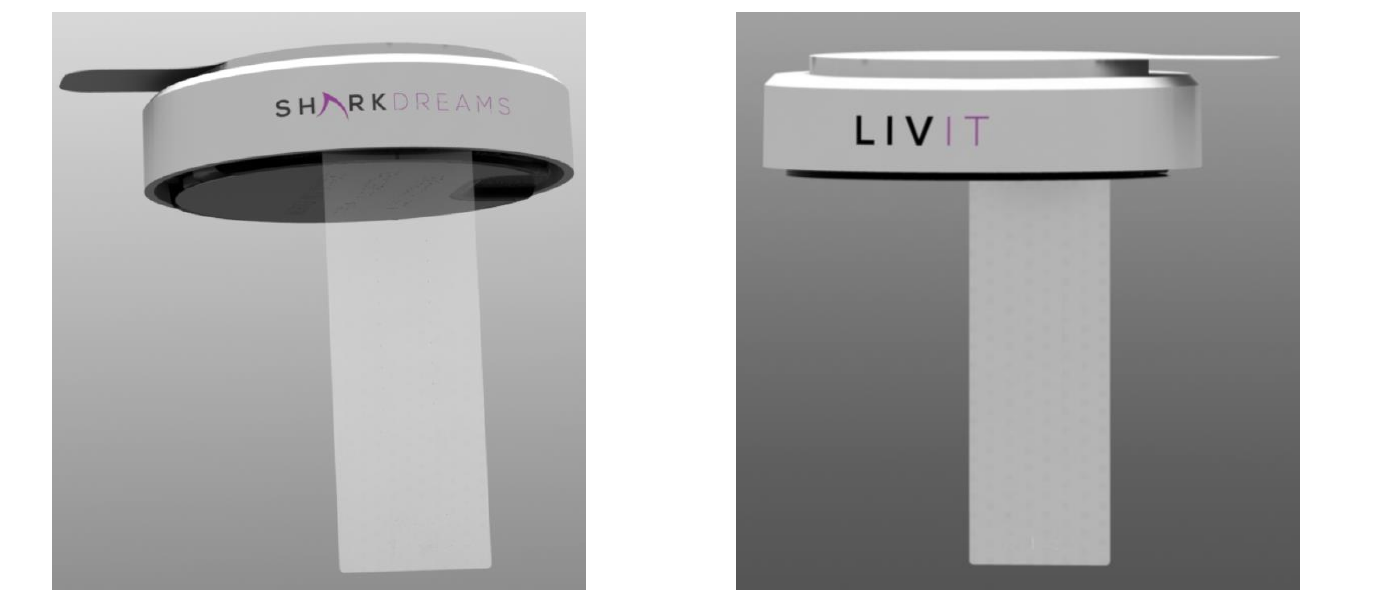
Cosmetic models — SharkDreams & LIVIT branding
The built device is a low-profile disc that couples to a standard pill bottle. Inside, a beam-style load cell
weighs the bottle; a drop equal to one pill confirms a real dose. Engineered with product-design firm Porticos —
38 mm × 9 mm, a ~40-day battery, and a foam-tape liner to seat on uneven bottles. A flexible printed-sensor
approach (SDX) was explored to keep it cheap and disposable.
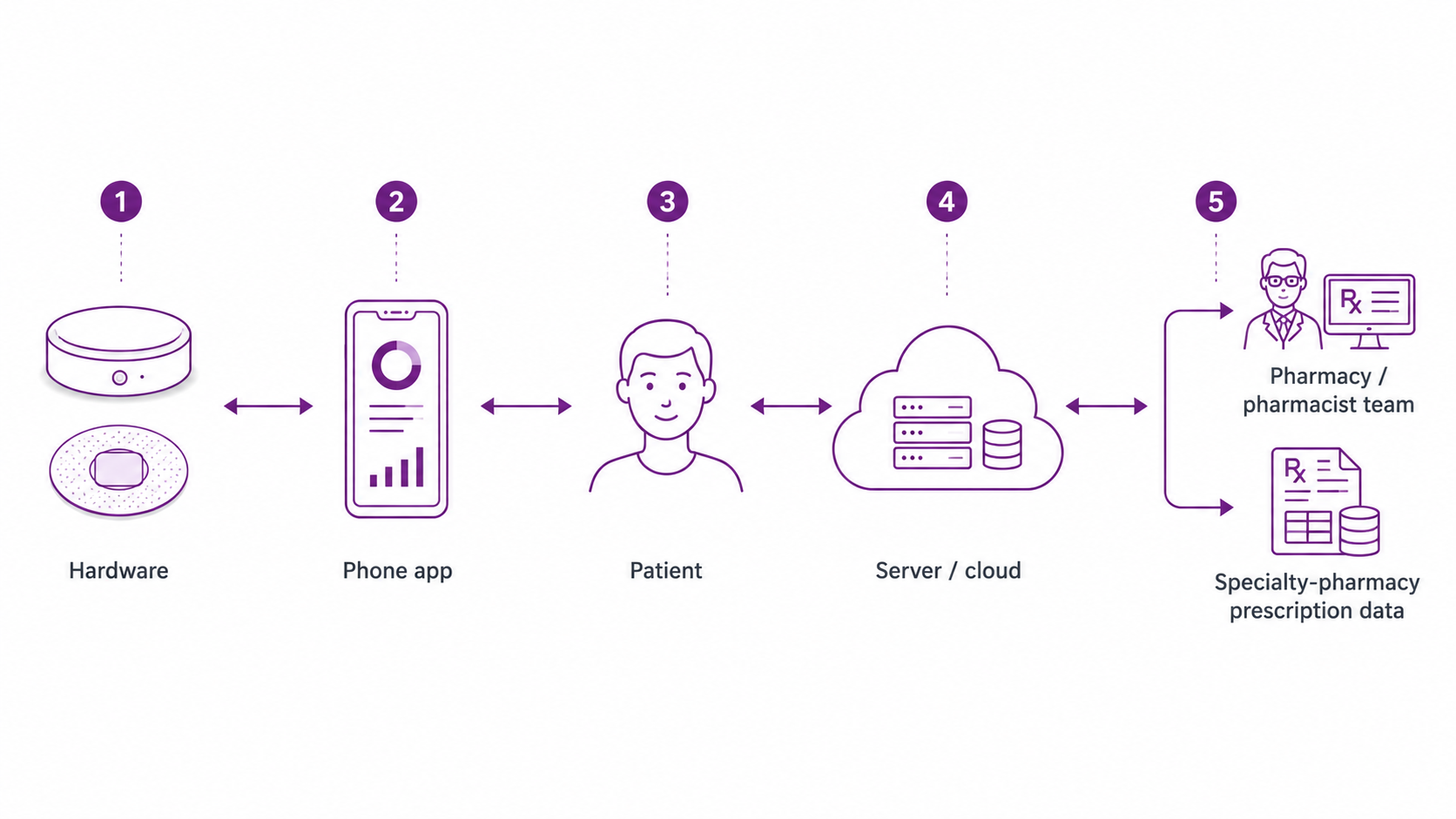
LIVIT is more than a device and an app: a connected platform linking the patient, the pharmacy, and the
provider. The signal moves through five links — device↔phone, phone↔patient, phone↔server, server↔pharmacy, and
server↔prescription data — turning raw dose data into pharmacist-ready action. Built HIPAA-compliant, with Business
Associate Agreements as real specialty-pharmacy clients onboarded (2018–2019).
The five links — hardware → phone → patient → server → pharmacy & Rx data
2017 — 2018The patchch.04
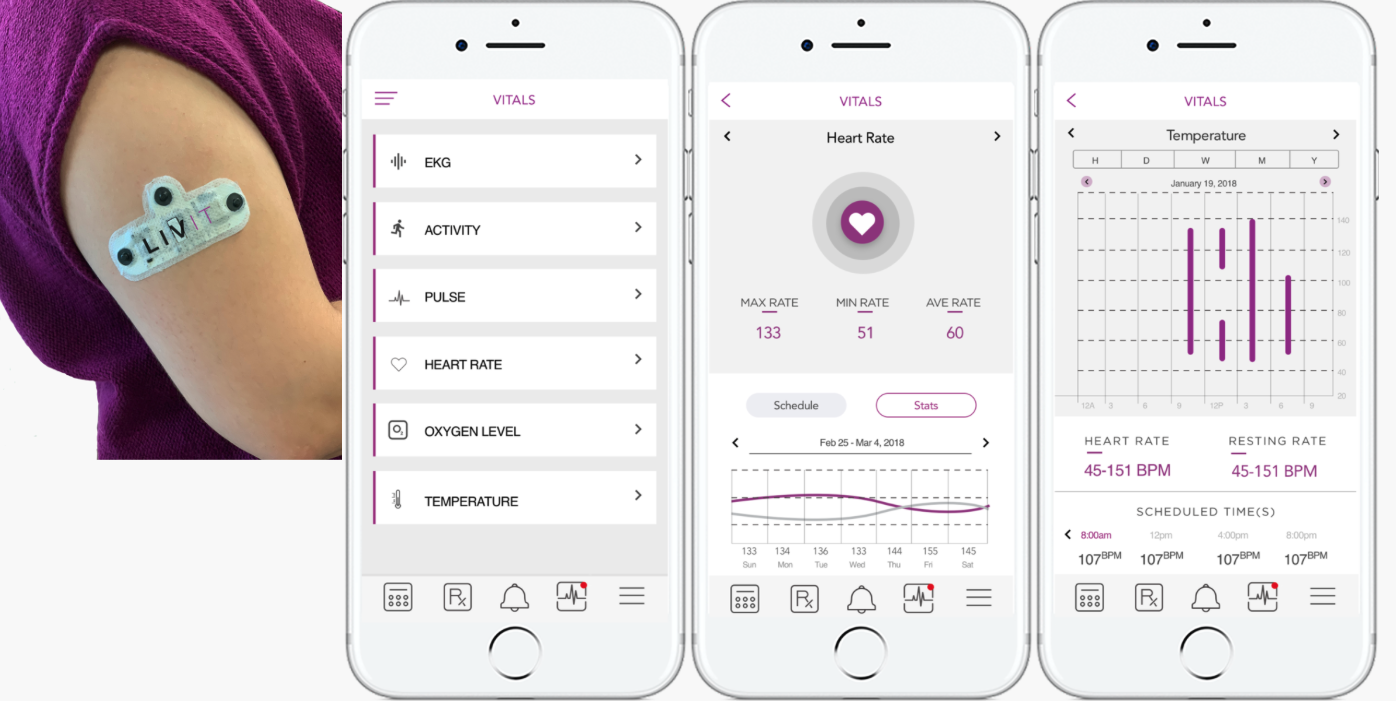
A vitals wearable — prototype only
The "SharkSkin" patch — evaluated in prototype only
A companion skin-worn patch ("SharkSkin") was engineered to read the vitals a medication can affect — skin
temperature, pulse oximetry, 3-lead ECG, accelerometry — so a provider could see not just adherence but response.
Developed by VieMetrics (an NC State University PhD team); it was used only in internal testing — never
commercially or clinically deployed, and the device IP belongs to VieMetrics.
2017 — 2019Manufacturingch.05
From a learning batch to real units
Building real hardware meant building a supply chain. The first 3,000-unit run (USA, ~$100K, ≈$33/unit) was a
supply-chain learning batch — not cost-optimized. The next batch came in around $15/unit, with under $10 the target
at higher volume. Component manufacturing also ran in India. The device was priced to the pharmacy at $25 per 90-day
device — deliberately near cost, because the value that justifies it is the recurring monitoring it enables.
A top PBM-owned specialty pharmacy — LIVIT Trial & License Agreement (2017) — an initial evaluation; the PBM of a major Medicaid plan family.
A national specialty pharmacy — LIVIT License Agreement (2018) with a HIPAA BAA added later; a multi-year engagement through 2021; part of a national managed-care organization.
A major health plan — an early health-plan engagement; A global cloud platform (secured chip) — a research-build collaboration on the secured chip, with a Düsseldorf pitch invite, but no formal partnership signed.
Both clients are Medicaid-managed-care anchored — so the real patient base skewed Medicaid (and dual-eligible), not pure Medicare.
2019 — Q1–Q3 refinements, mini-trials, and pharmacy-staff training.
Built with design partner Generate Design and development partner Imaginovation, alongside SharkDreams engineering.
2017 →IP & partnersch.08
Patents, a trademark, and the team that built it
Patents — a PCT (international) application documents the Smart Healthcare Kit system architecture; a provisional patent (720-5, Oct 2017) covered the patch (later expired).
Trademark — the LIVIT mark was filed in 2017 (USPTO + Madrid); the U.S. mark later went abandoned in 2019.
Engineering partners — Generate Design (UI/product), Imaginovation (app dev), VieMetrics (hardware/board & the patch), Porticos (mechanical/product), a global cloud & silicon platform (secured chip).
For the recordThe full recordend
This is a factual account of prior product development; every figure traces to an original design, agreement, or patent
document. SharkDreams, Inc. is a prior venture and was the subject of an SEC matter, with a final judgment entered
March 2025; the complete public record is available at sec.gov. This site is an
informational engineering and heritage portfolio — nothing here is an offer to sell, or a solicitation of an offer to buy,
any security or investment, and no investment opportunity is being offered. Not legal or financial advice.
 SHARKDREAMS